
Do not buy a Leica M EV1, get the Visoflex instead
A $250 accessory that makes a $9,000 camera pointless
Some months ago, Leica released the M EV1, a camera that strips the rangefinder from an M11-class body and replaces it with a built-in electronic viewfinder.
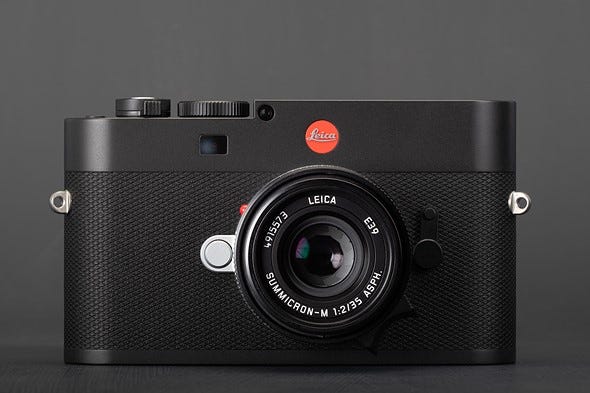
At $8,999 (+tax!), it’s Leica’s answer to photographers who want M lenses without the rangefinder learning curve. The sensor is the same 60 MP full-frame chip found in the M11. The EVF runs at 5.76 million dots, borrowed from the Q3 family, though capped at 60fps instead of the Q3’s 120fps. The body looks almost identical to an M11-P.
In plain terms: it is an M11 without a rangefinder and with a built-in EVF where the finder used to sit.
For current M10 and M11 owners, this raises a question worth thinking through: why spend $9,000 on a new body when the Visoflex already solves the same problems, for a fraction of the cost?
What the Visoflex actually is
The Visoflex is Leica’s hot-shoe-mounted electronic viewfinder for M cameras. Slide it onto the hot shoe, and your rangefinder becomes a mirrorless-style camera with live view, focus peaking, and magnification. Remove it, and you’re back to the pure rangefinder experience. There are two modern versions: the Typ 020 (for M10 bodies, with GPS built in) and the Visoflex 2 (for M11, with a 3.7 MP OLED display).
Although the above picture shows the Visoflex 2, I prefer the previous version, the Typ 020 (a.k.a. Visoflex 1).
Between the two, the Typ 020 has something the Visoflex 2 lost: mojo. The newer version is more refined but also more fragile, with a known dust problem around the diopter dial. Many owners tape it shut right after purchase. The older Typ 020 feels sturdier, more mechanical, and frankly more at home on a rangefinder camera. If you shoot an M10, the Typ 020 is still the better pick, both in feel and because it adds GPS geotagging with zero extra steps.
Don't buy the Leica M EV1
There are five good reasons to stick with the digital Leica M body you might already have:
1. You keep the rangefinder. The M EV1 asks you to give up the one thing that makes an M camera worth owning. With a Visoflex on your M10 or M11, the optical finder is always there. You shoot with it for street work, travel, and anything that benefits from the speed of a split-image patch. The Visoflex goes on when you need it and comes off when you don’t.
2. Battery drains slower when you control it. The M EV1’s EVF is always on. One user averaged around 350 shots per charge shooting in EVF mode. With a Visoflex, you remove it the moment it isn’t needed, and your battery lasts as long as it normally would.
3. It tilts to 90 degrees. Both the Typ 020 and Visoflex 2 tilt upward to 90 degrees, letting you shoot from waist level while looking straight down into the finder, like a medium format camera. The M EV1’s built-in EVF sits fixed to the body. You don’t get that option.
4. Vintage and non-coupled lenses become usable. Ultra-wides like 21mm, telephotos at 90mm and beyond, Leica R lenses via adapter, old Soviet glass, anything that doesn’t couple to the rangefinder mechanism works correctly through the Visoflex. You see exactly what the lens sees, with focus peaking and magnification. This is one of the strongest practical arguments for the Visoflex that rarely gets enough attention.

5. The price difference is hard to ignore. A Visoflex 2 runs around $650 new. The Typ 020 goes for even less. And right now, used prices have dropped further because the M EV1 announcement caused a wave of people selling their Visoflex units in a panic. That panic is your opportunity. You can find a Typ 020 or Visoflex 2 on eBay for well under $500, sometimes significantly less, at a moment when the accessory has never been more capable or relevant.
Something I forgot to add to this post
a.k.a. “Ok Raf, how does the shit look like”, give me a video, bro…
What the M EV1 does better
The EV1’s EVF is sharper at 5.76 MP versus the Visoflex 2’s 3.7 MP, and integrated directly into the body without any lag from the hot shoe connection. If you’re shooting a Noctilux at f/0.95 on fast-moving subjects, the EV1 offers more focus confidence. It also removes the risk of the Visoflex collecting dust in the diopter or sliding off the hot shoe.
That said, the 5.76 MP EVF runs at 60fps. The Q3, a camera that costs less than the EV1, ships with the same resolution finder at 120fps. Leica is asking you to pay a premium M price for an EVF that’s already behind another camera in their own lineup. For $9,000, you’d expect the best EVF Leica makes. You’re not getting it.
What do I think?
Spending $9,000 on the M EV1 when you already own an M10 or M11 is hard to justify. The M EV1 gives you an EVF, live view, focus peaking, and compatibility with wider and longer lenses. The Visoflex gives you all of that too, for a few hundred dollars, without asking you to abandon the rangefinder that makes the M system what it is.
The EV1 is not a smarter camera. You lose the optical finder permanently. You lose the ability to shoot waist level. You lose battery flexibility. You gain a built-in EVF that runs at 60fps, slower than what Leica already ships in the Q3. For a body at this price, that’s simply unnaceptable.
If you’ve been sitting on the fence about picking up a Visoflex, this is actually the best moment to buy one. The EV1 launch shook the used market and prices dropped. People panicked and listed their Visoflex units well below what they were selling for six months ago. The smarter move is to take advantage of that, keep shooting your M the way it was meant to be shot, and spend what’s left on film, glass, or anything else that actually improves your photography. I got mine for $250 used in Mint condition.


But only if you don’t need a hot shoe for a flash. ;-)
It’s still one of the biggest drawbacks of Leica M cameras if you shoot models / do portrait work.
Also - I just got Thypoch 21/3.5. I also picked up a Voightlander 21mm bright line viewfinder. I was on the fence about getting a VisoFlex yet since with the 21mm I don’t have to worry about critical focus (stop down and everything is in focus), I decided on the viewfinder to just assist with framing/composition.