


This post is sponsored by Gelatin Labs. Originally posted in Portuguese in Fotografia Cotidiana.

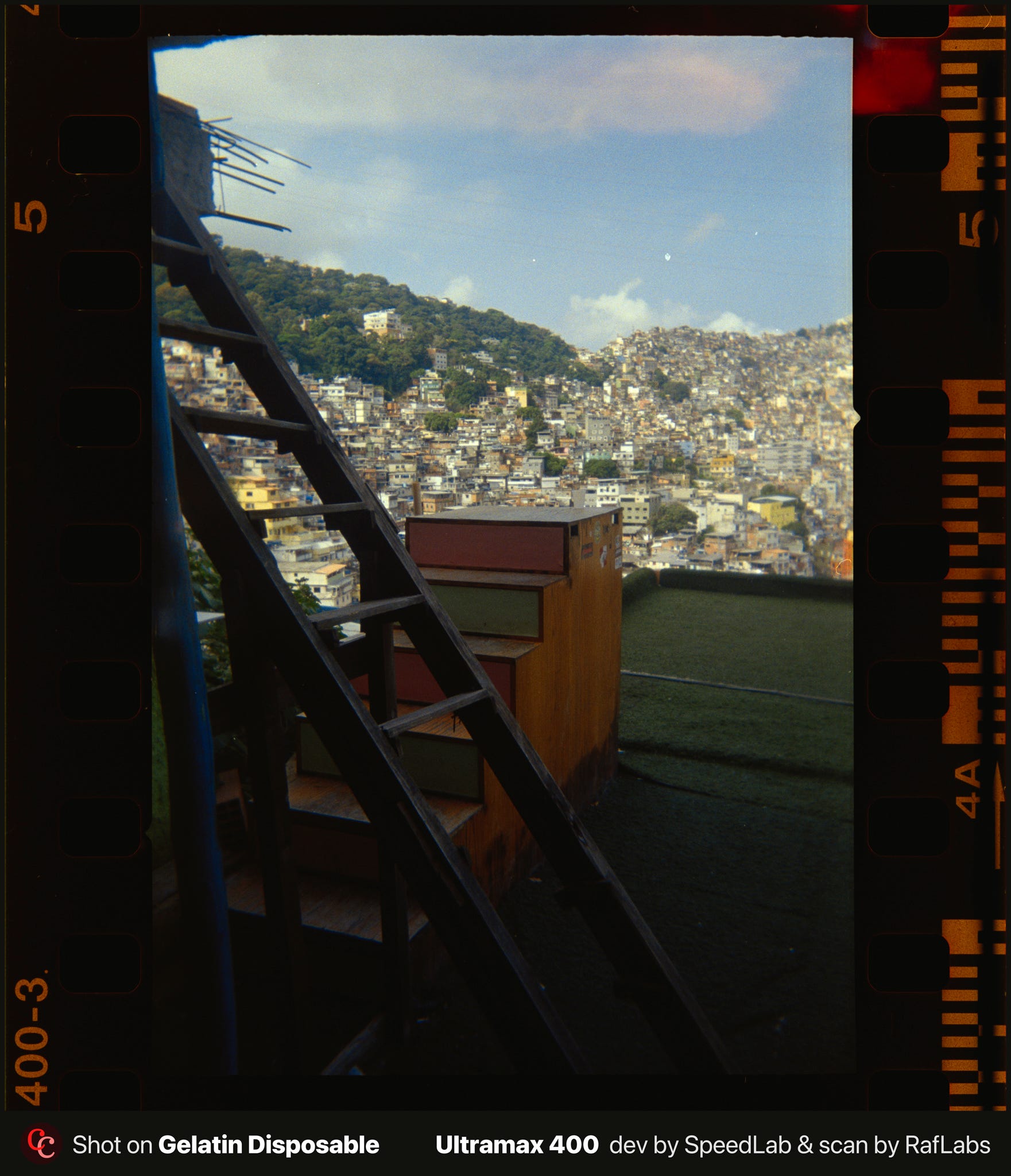
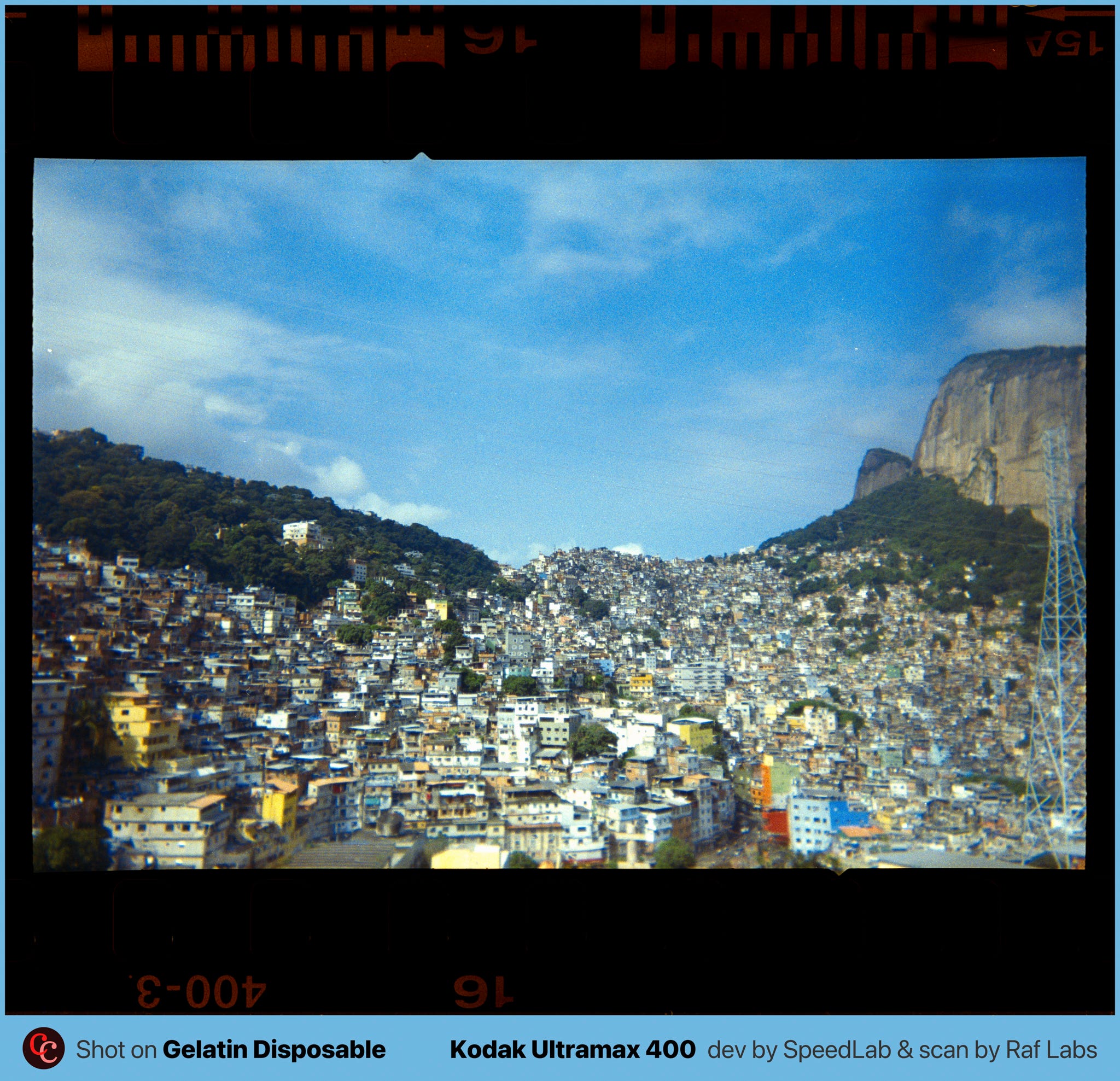
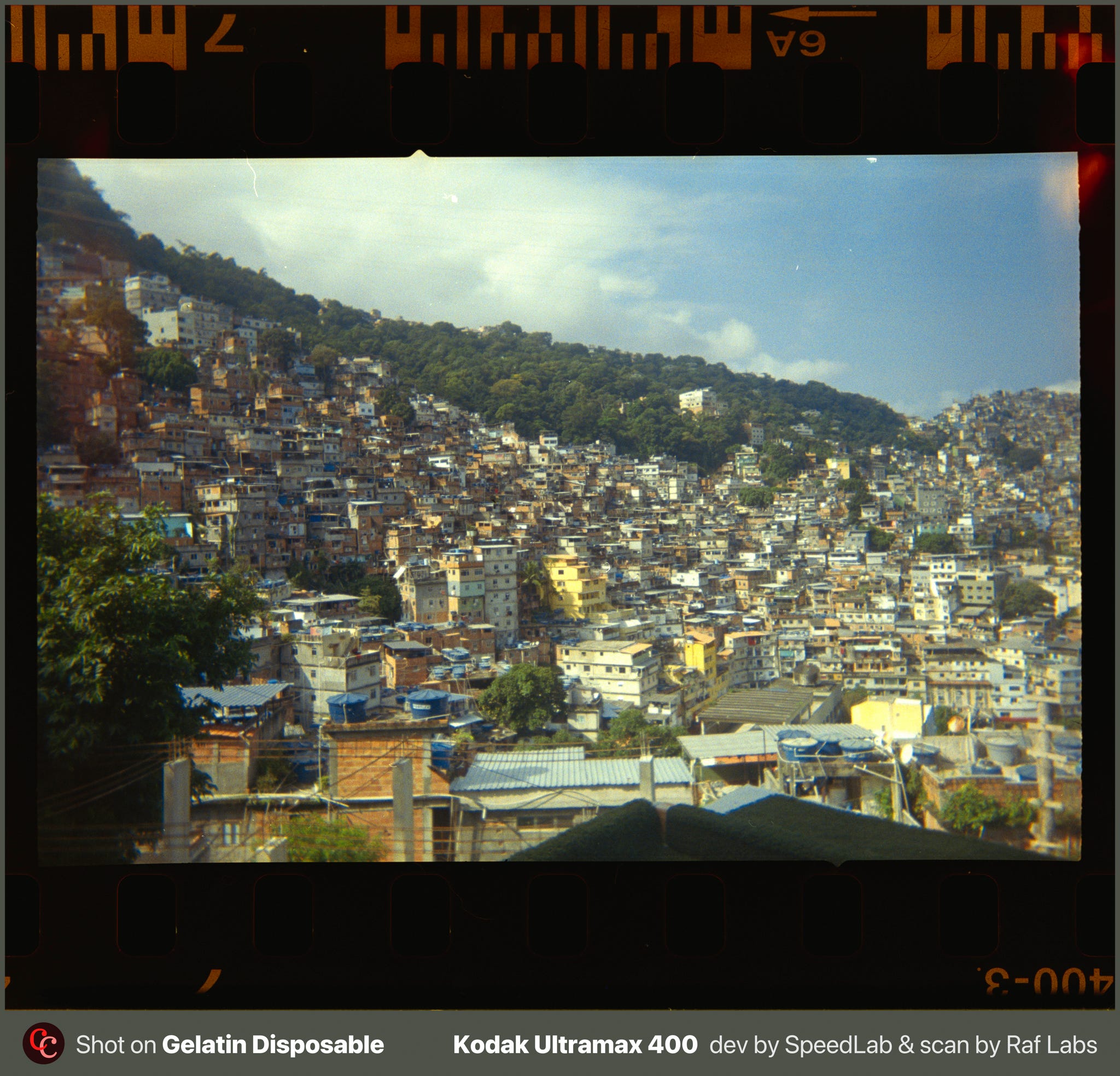
I had never set foot in a favela. I lived in Rio for thirty years, always with Rocinha right there, visible from every corner of the Zona Sul (or from the traffic if you were driving past), and I never once went in. From a distance it looks like a painting: the biggest favela in Brazil, made up by thousands of houses stacked up the hillside, each one with its little blue water tank on top, lights at night as if the sky had slipped down onto the slope. Up close, I had no idea. And I had no idea because I never went. Thirty years living next door and I never went. That sentence alone says a lot about the kind of prejudice we carry without realizing it. I didn’t avoid Rocinha for any concrete reason. I avoided it because I absorbed the idea that it wasn’t for me, that it was dangerous, that there was nothing interesting in there. The whole city works like this: the favela is right there, everyone sees it, and almost nobody goes in. This post is, among other things, an attempt to dismantle some of that prejudice.
The idea came up while I was still in New York, planning the trip. I knew I wanted to do something in Rocinha, photograph it somehow, but I didn’t know exactly what. I thought about those Instagram drone videos, about those jeep tours they do for foreigners, or about just staying on the outskirts. My friend Edgard, who lives in São Conrado, was going to set something up. The plan was simple: barbecue at his place, then go see Rocinha.
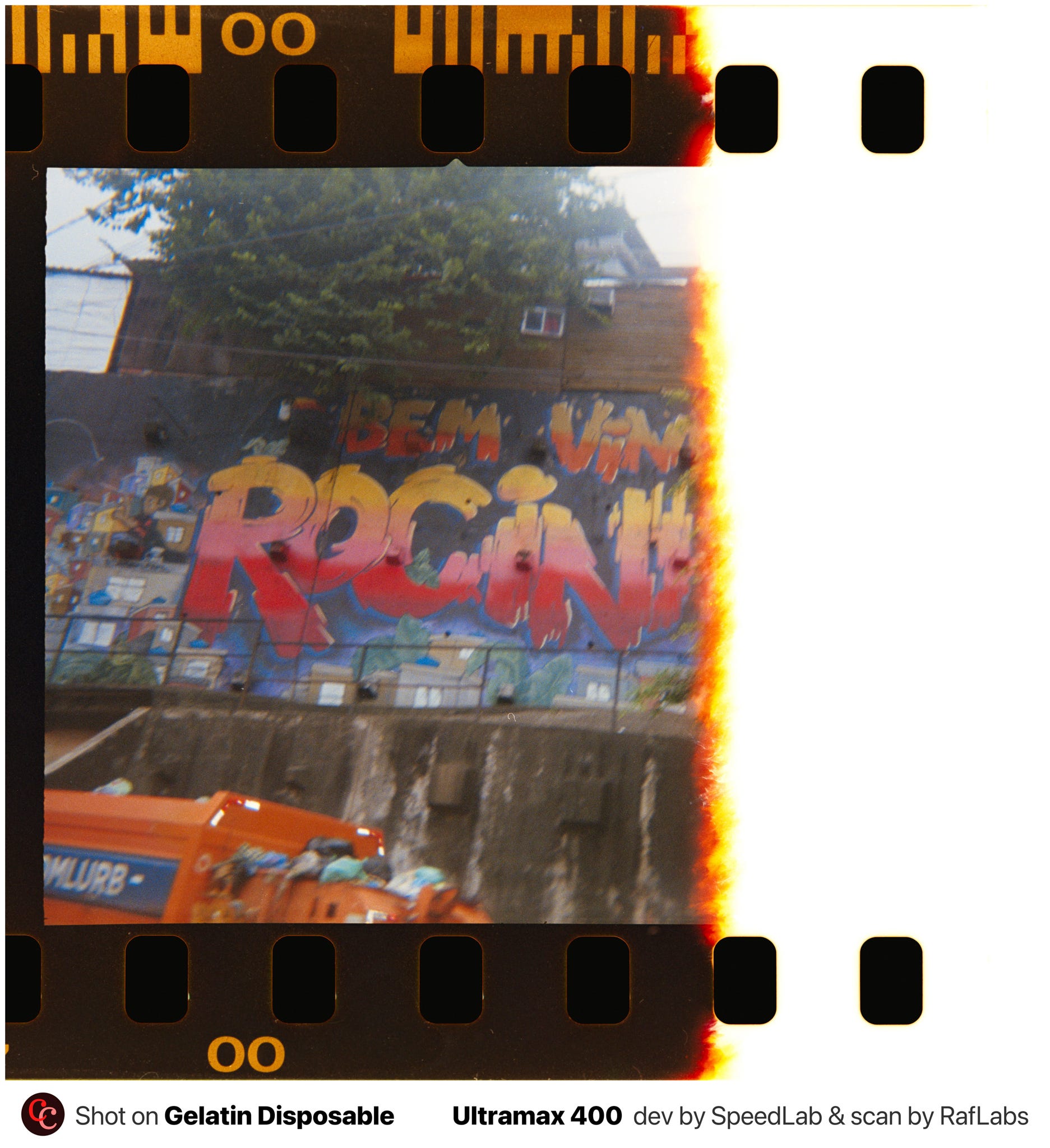

What happened was, on the day of the barbecue, the barbecue gas tank ran out. Edgard went up to Rocinha to buy a new one and, while he was there, asked one of the mototaxi (motorcycle+taxi) drivers at the base of the hill what the best way to do a photography tour would be. The guy asked if we wanted the tourist experience or the real thing. Edgard, Rio born and raised, asked for the real thing. The guy suggested going by mototaxi. And just like that, from an empty gas tank, one of the most striking experiences of my life was born.
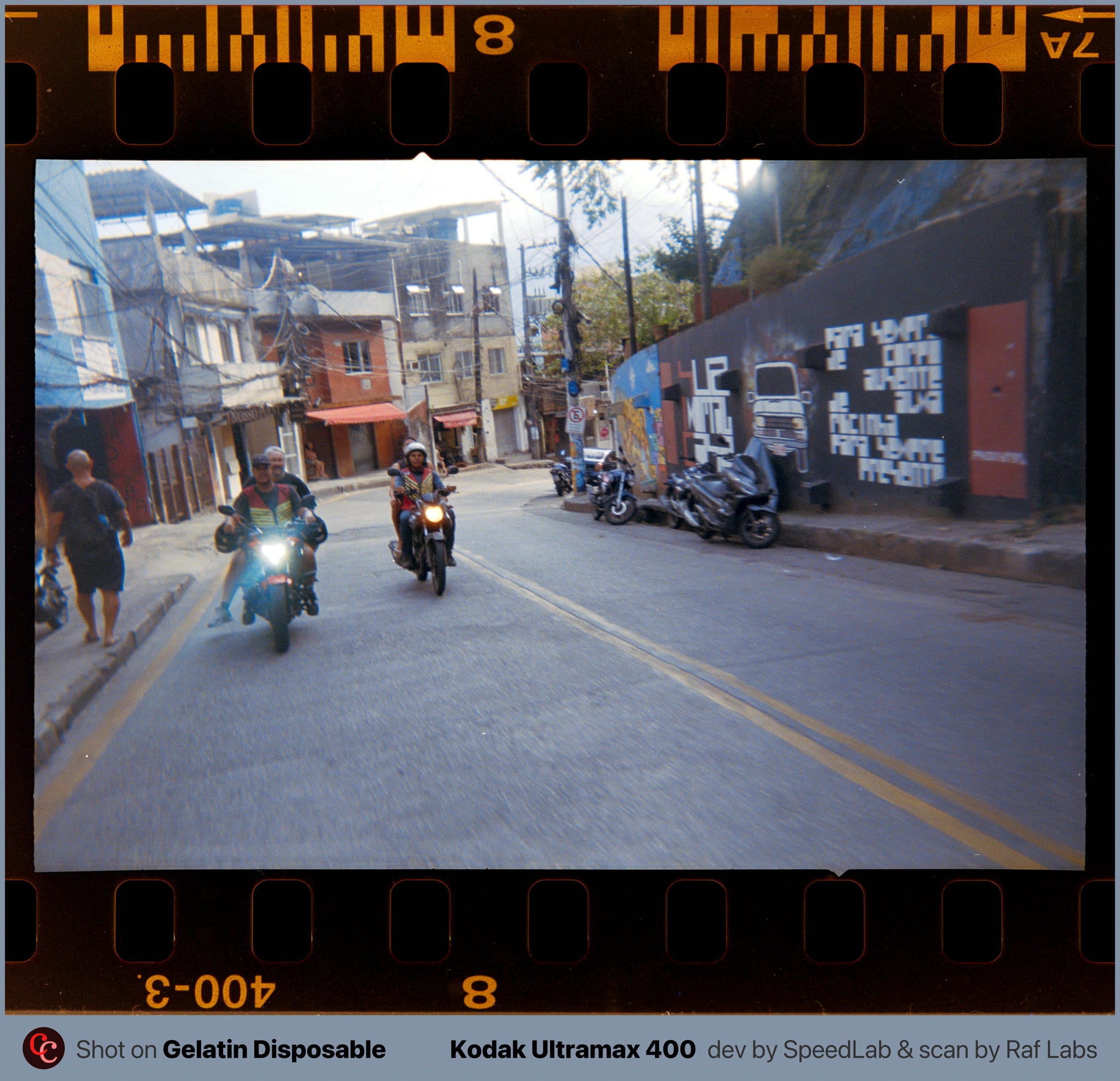
I went up prepared to feel vulnerable. I brought disposable cameras from Gelatin Labs. One in my pocket, another in Edgard’s, light enough not to draw attention and cheap enough not to hurt if they disappeared. Phone in the other pocket. No good camera, no Leica, and I regret that a little, because I still haven’t developed the film from the disposables as I’m writing this. That choice to leave the good camera at home also says something…
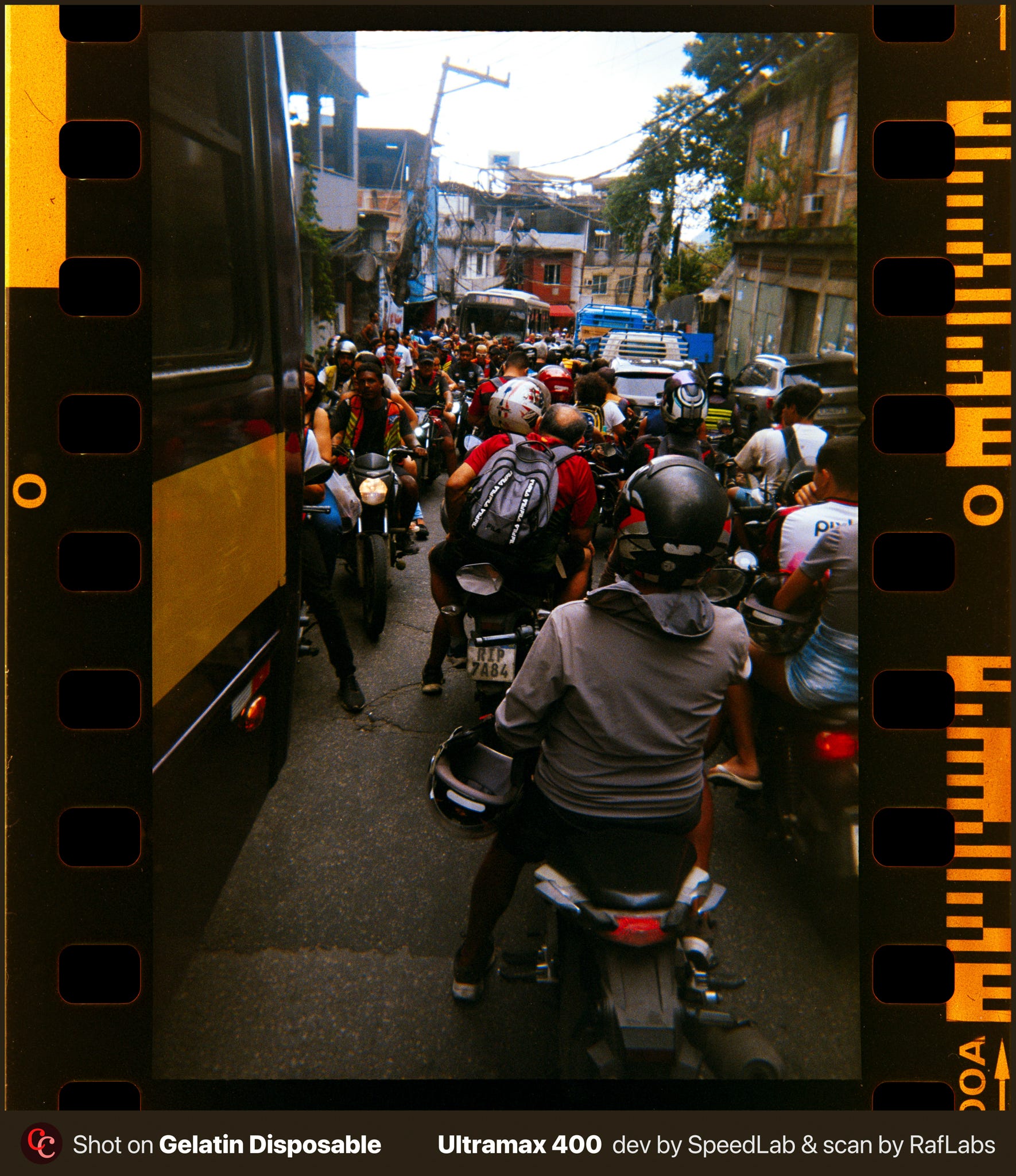
I went afraid of being robbed in a place where, in the end, nobody even glanced at my pocket. We plan these visits based on what television and Instagram have sold us, not based on what the place actually is.
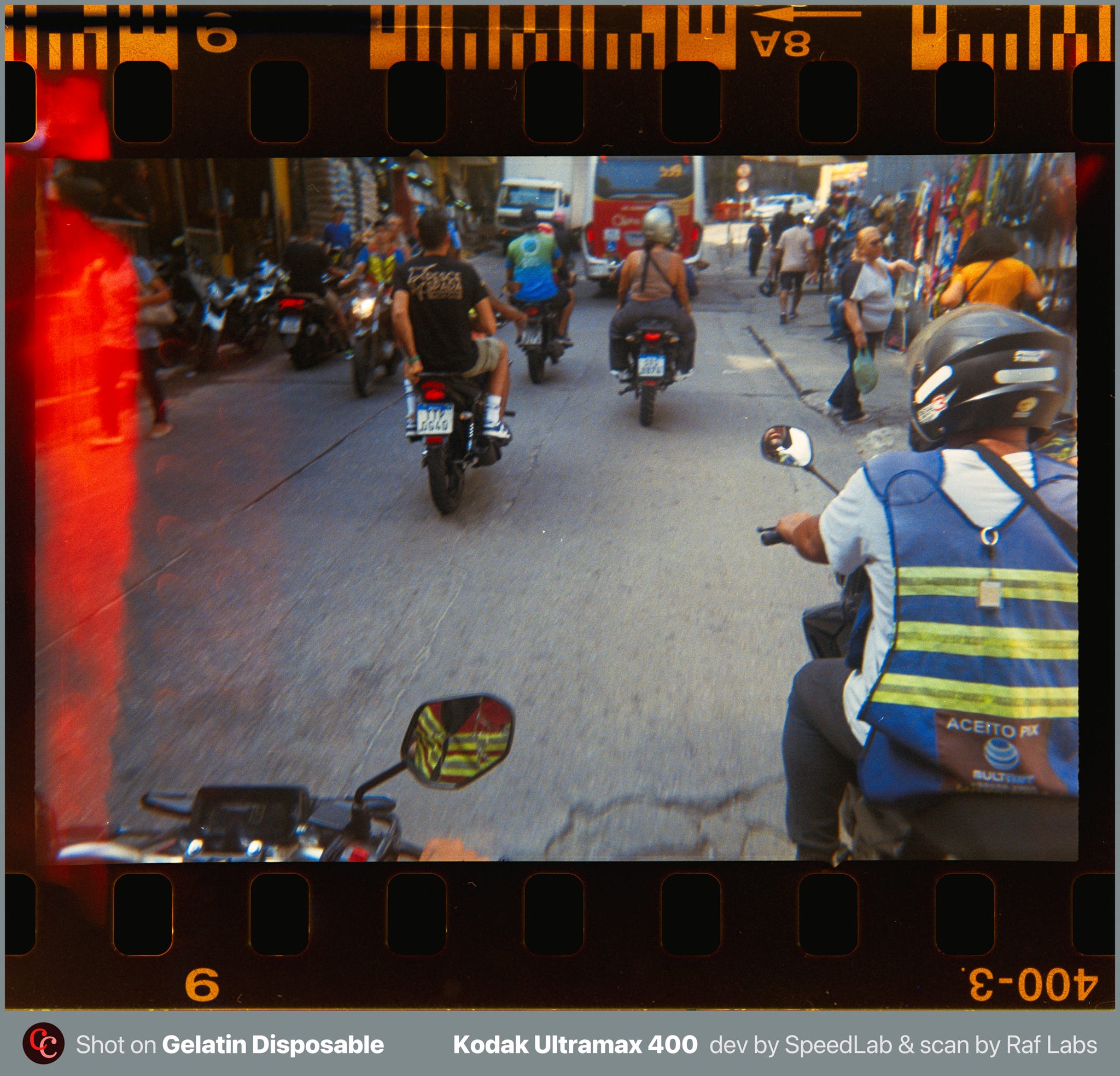
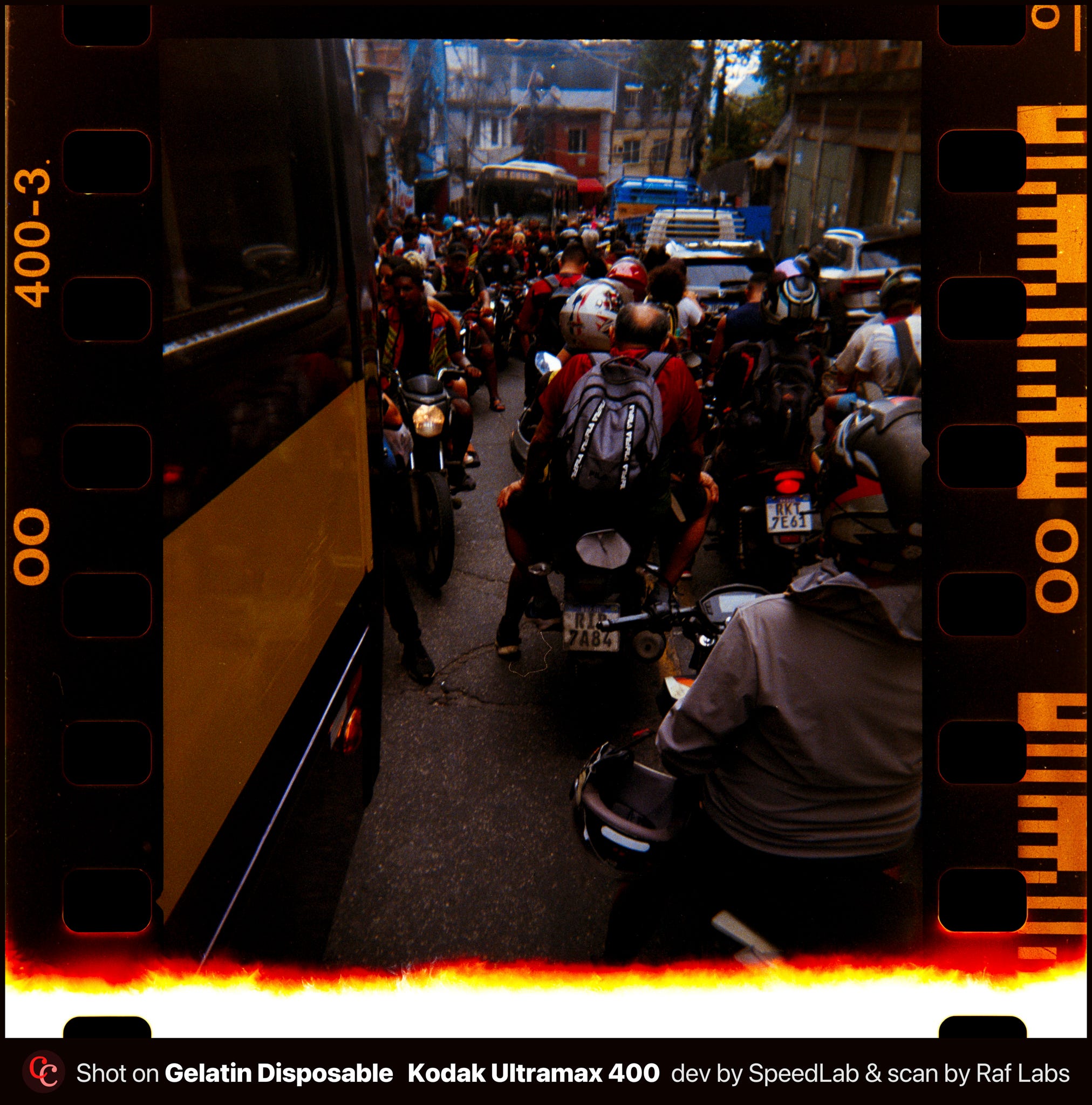
It was me and Edgard, each on the back of a mototáxi, one behind the other. The climb is steep and the streets are narrow, the kind of street that doesn’t show up on Google Maps because the satellite image is swallowed by the swarm of houses. The driver dodged pedestrians, other bikes, dogs, kids, all of it at a speed that wasn’t fast but felt fast because the space was so tight. The self-organization of the whole thing is as efficient as a beehive, one that happens to have its King Drone somewhere up there (if you know what I mean…)
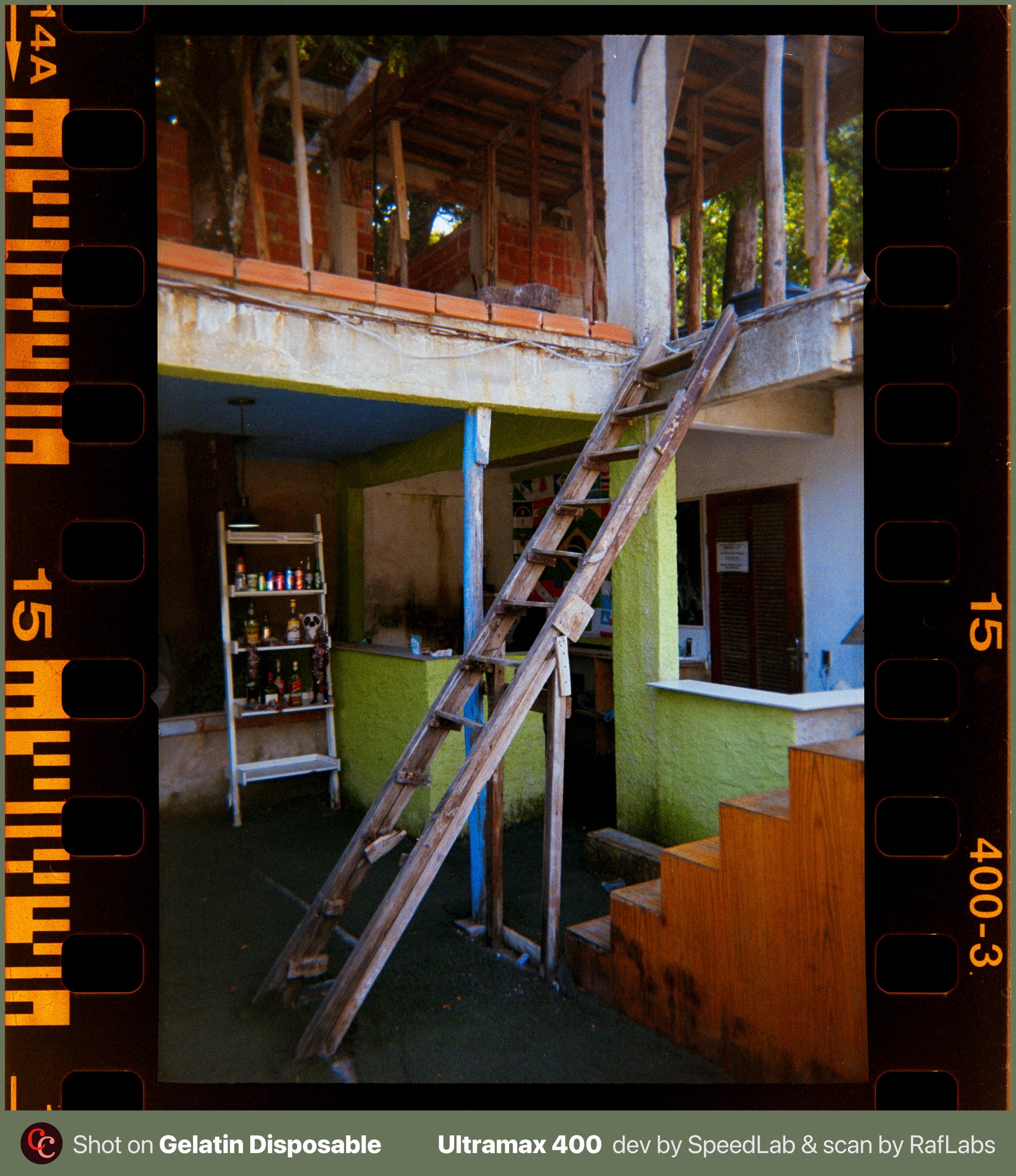
When the motodriver stopped at a point and rode off to turn the bike around, pointing it toward the next destination, I admit a small wave of panic hit. I’d look around, see dozens of alleyways branching off in every direction, and think: if this guy leaves me here alone, I am completely lost.
But he didn’t leave. And what he showed us was worth every second of unease.
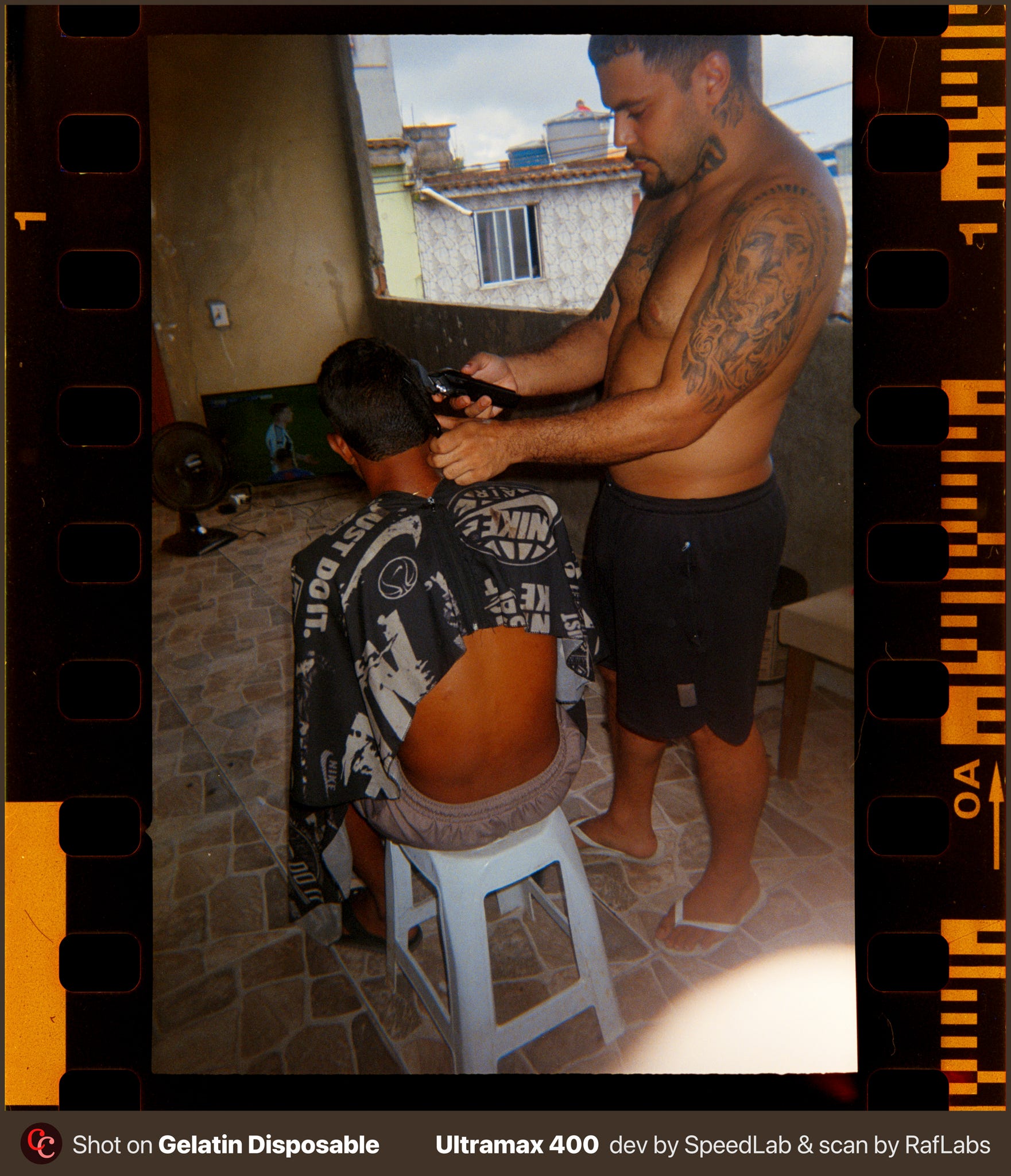
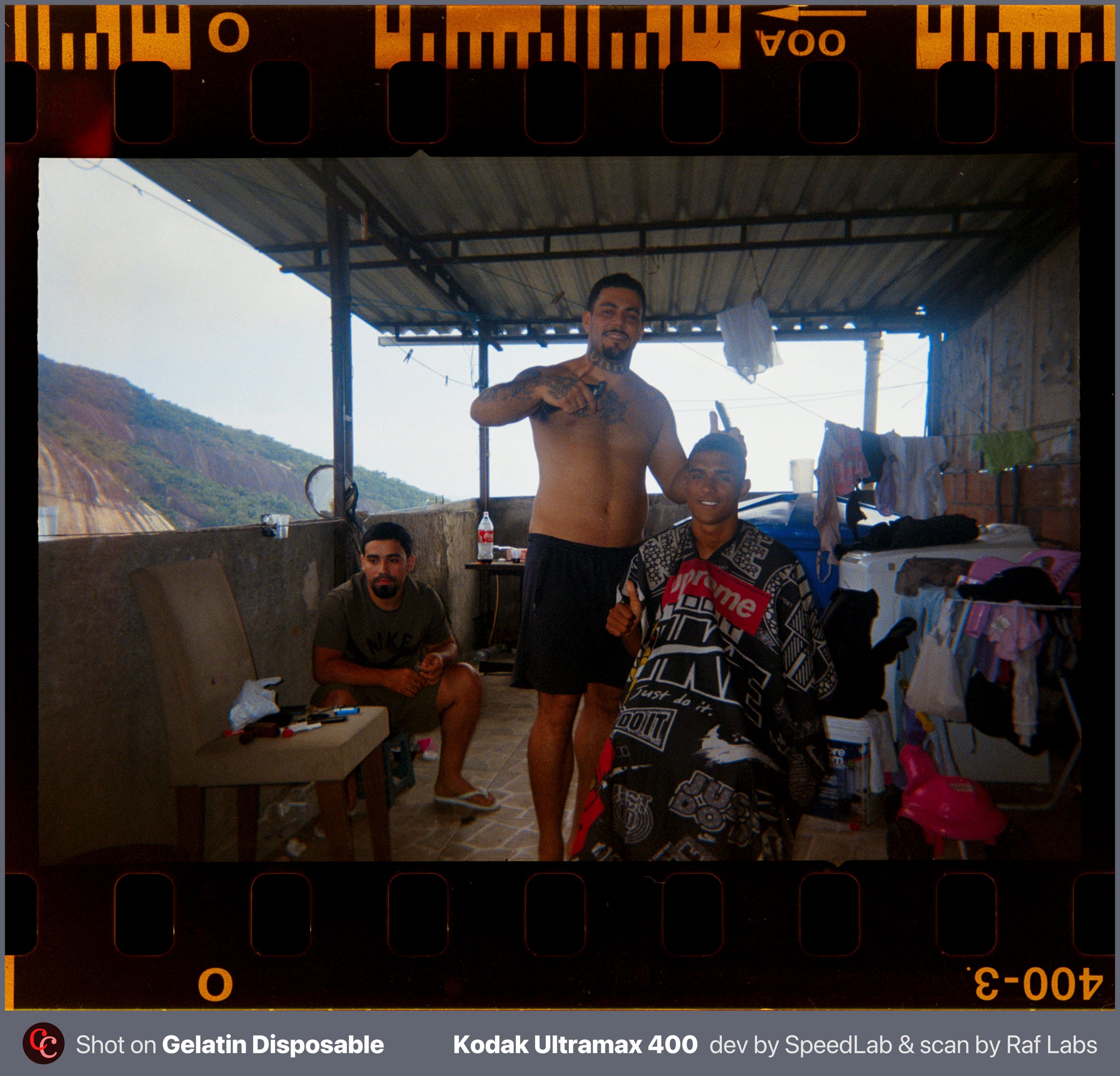
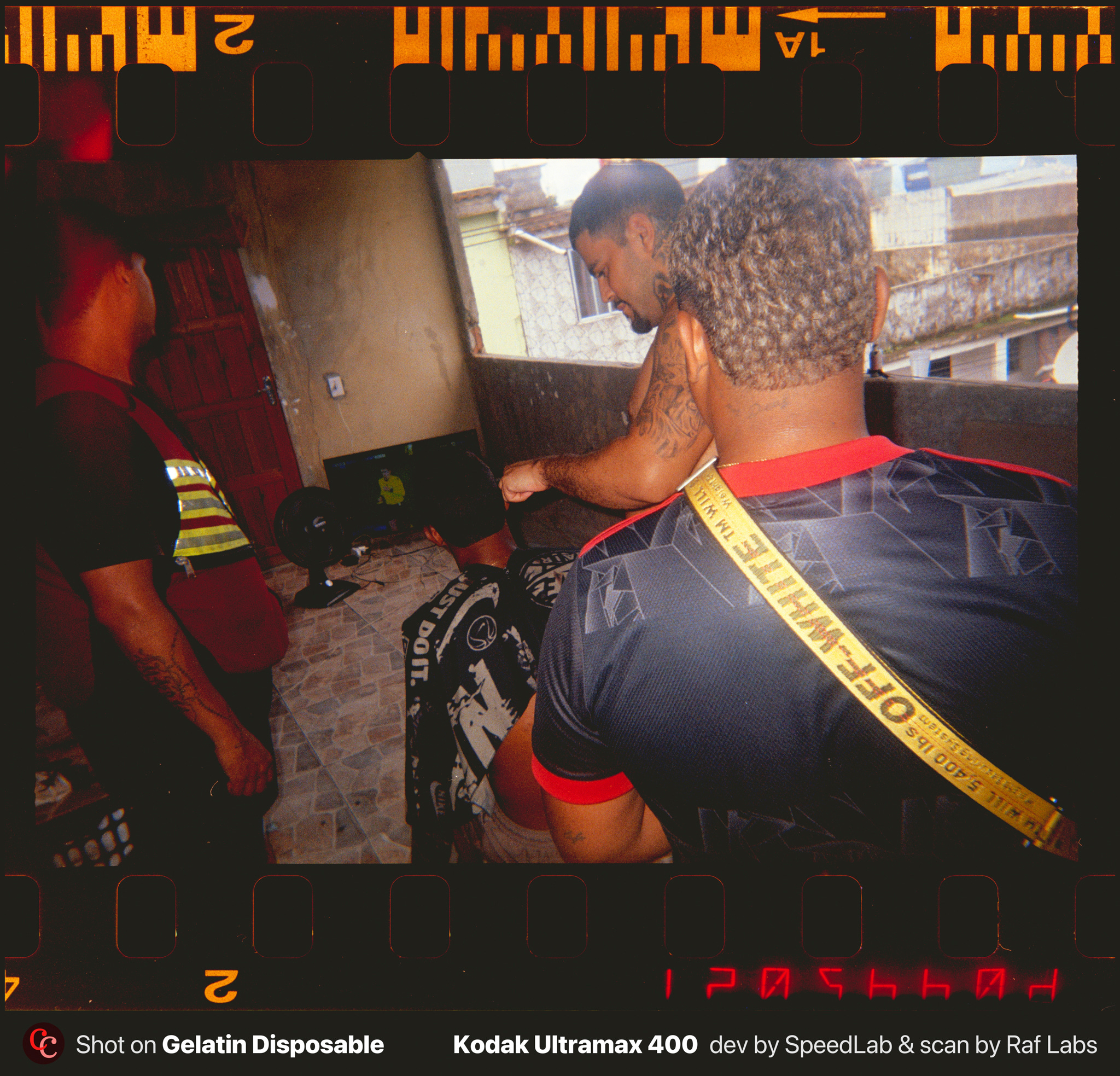
Our guide took us to a barber at the top of the favela. A guy cutting his hair on a rooftop terrace, watching football on a makeshift TV, with a view I’ve never seen anywhere else. On one side, São Conrado and the ocean. On the other, the Rodrigo de Freitas Lagoon and the entire Zona Sul (the most noble and expensive part of Rio). That view only exists there, at that exact spot. No five-star hotel, no tourist lookout delivers that. The barber working calmly, the TV tuned to an Eurocup match, Barcelona was playing. He had the entire city at his feet with that view. The simplicity of that scene stayed with me more than any postcard.
There are parts of the route I took where you can’t take photos or film. Our guide warned us ahead of time and we respected it religiously. The reason is practical: there are areas where people walk around armed, and I’m not talking about pistols. Military-grade rifles, as tall as the person carrying them. The community wants to protect its external image and prevent visitors from filming only that and posting it online. Fair enough. And that is exactly the point. If you search “Rocinha” on YouTube, most videos show guns and tension. That’s the clickbait culture of our current society. Nobody films the barber on the rooftop, the football tournament in the alley, the mother walking her kid to school in the morning. The favela gets reduced to what scares people, never to what works. In one of those alleys, on the way to see a football pitch where local tournaments are held, we crossed paths with two young men carrying rifles. I did what any polite person would do: I said “good afternoon.” The young man replied “good afternoon, sir,” with a naturalness that disarmed me more than I was already disarmed.
Rocinha is controlled by the Comando Vermelho (CV), the largest criminal faction in Rio de Janeiro. The territory was taken from the former group Amigos dos Amigos (Friends of Friends) in 2018. Even so, there is an internal order. Our guide explained that inside the favela, physical fights are forbidden, that everything must be resolved through dialogue, that conflict within the community is not tolerated. And there is a protection for visitors: if something happens to us on a tour, the person who suffers the most consequences is the one responsible for the visit (in this case, the mototaxi drivers).
On the way down, motorcycle traffic was heavy and everyone was socializing. Mototaxi drivers greeting each other, chatting in the middle of the street, laughing, cracking jokes. A loudspeaker van blasting ads for a Northeastern food stand. I filmed a little on my phone. I saw a motorcycle hit a bus on the way down, the rider fell but got up without much damage. Life went on.
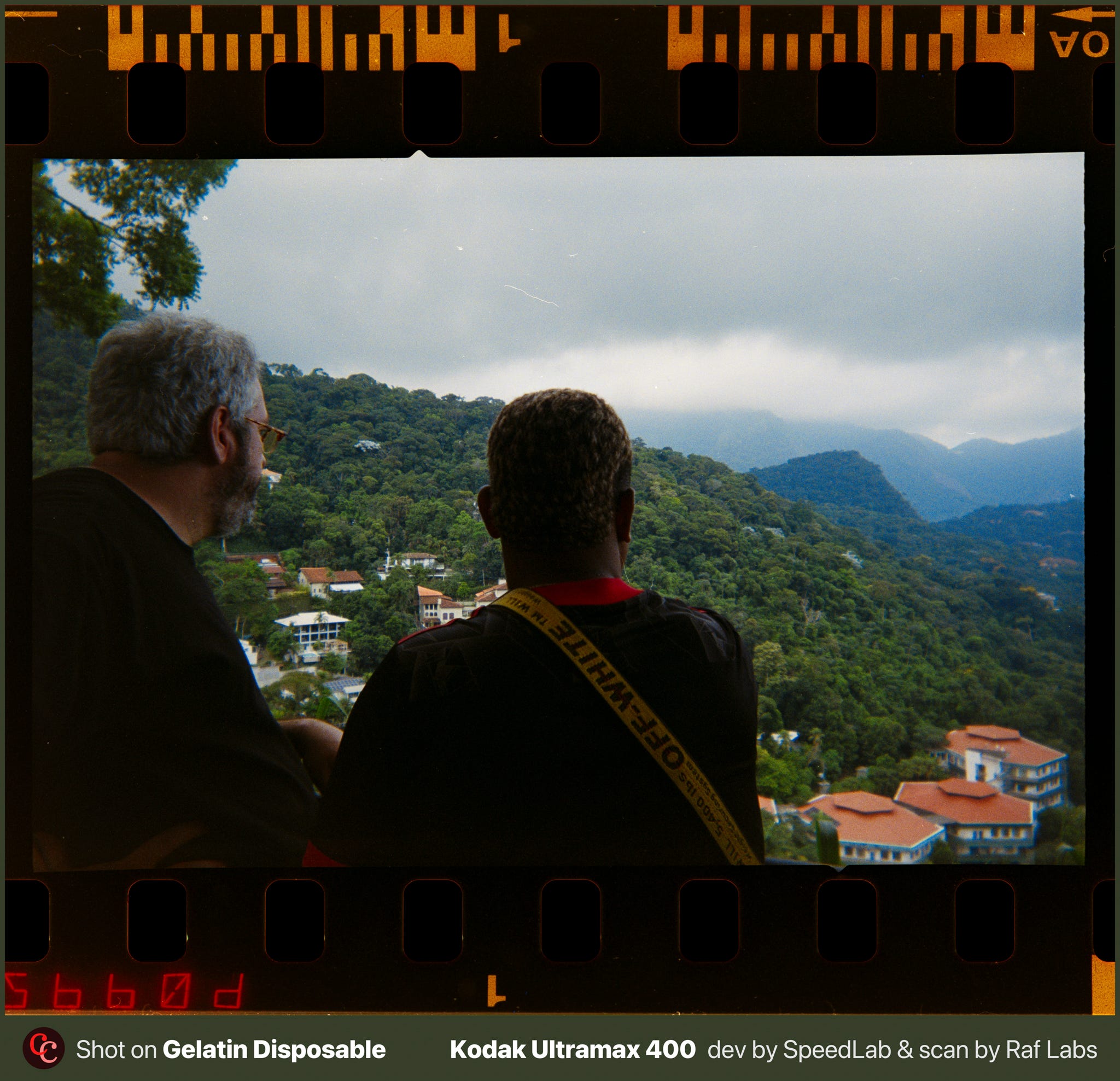
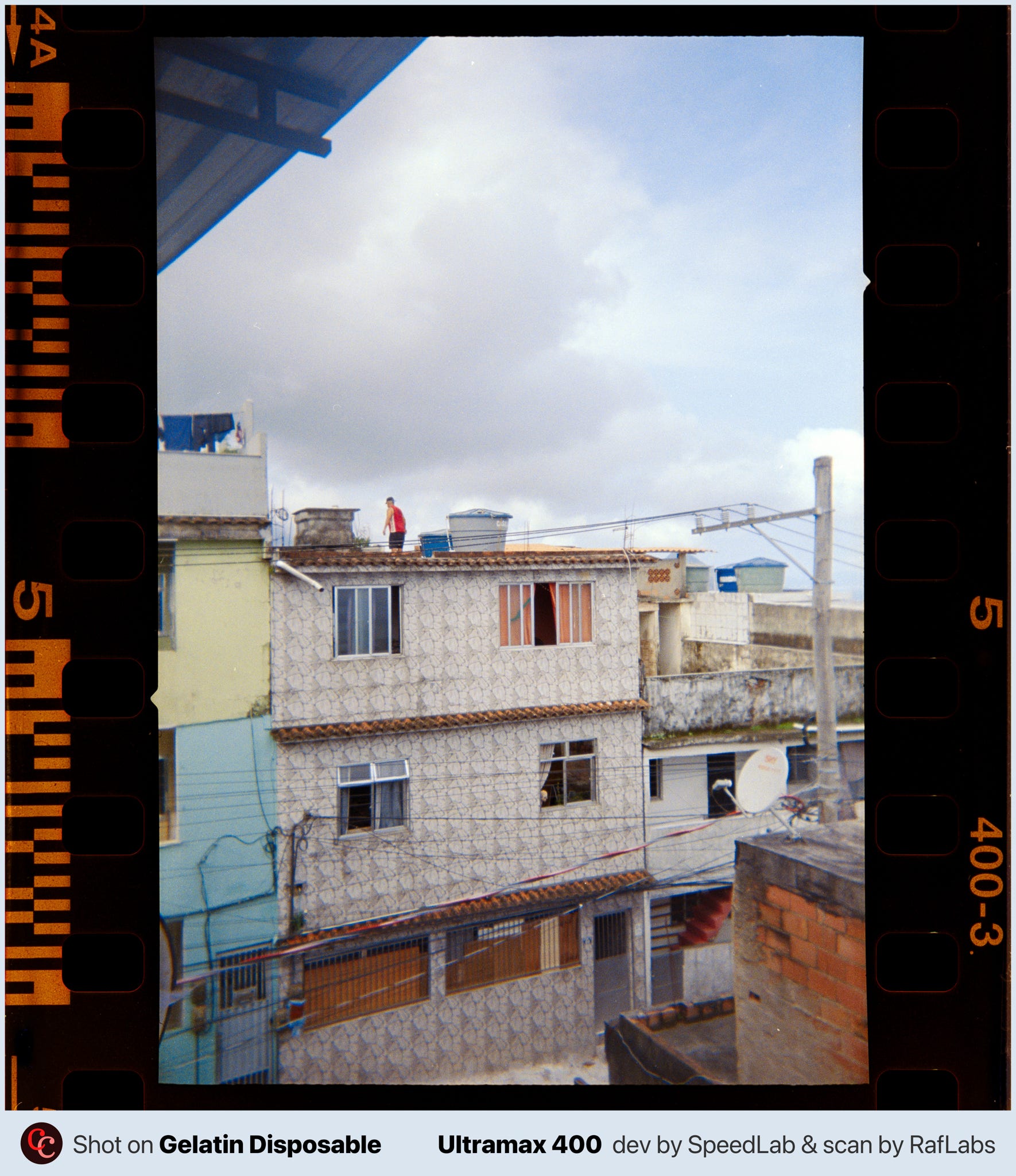
What impressed me the most, looking back, were two things. The first is the absurd number of photographic scenes that exist in that area. Rocinha is a territory practically untouched in the world of photography books, and every corner delivers a ready-made composition. Light, texture, layers, life. Next time, I’m bringing the Leica. Because it is safe, yes. The picture the media paints about what happens inside the favela is very different from the reality of those who live there and those who visit.
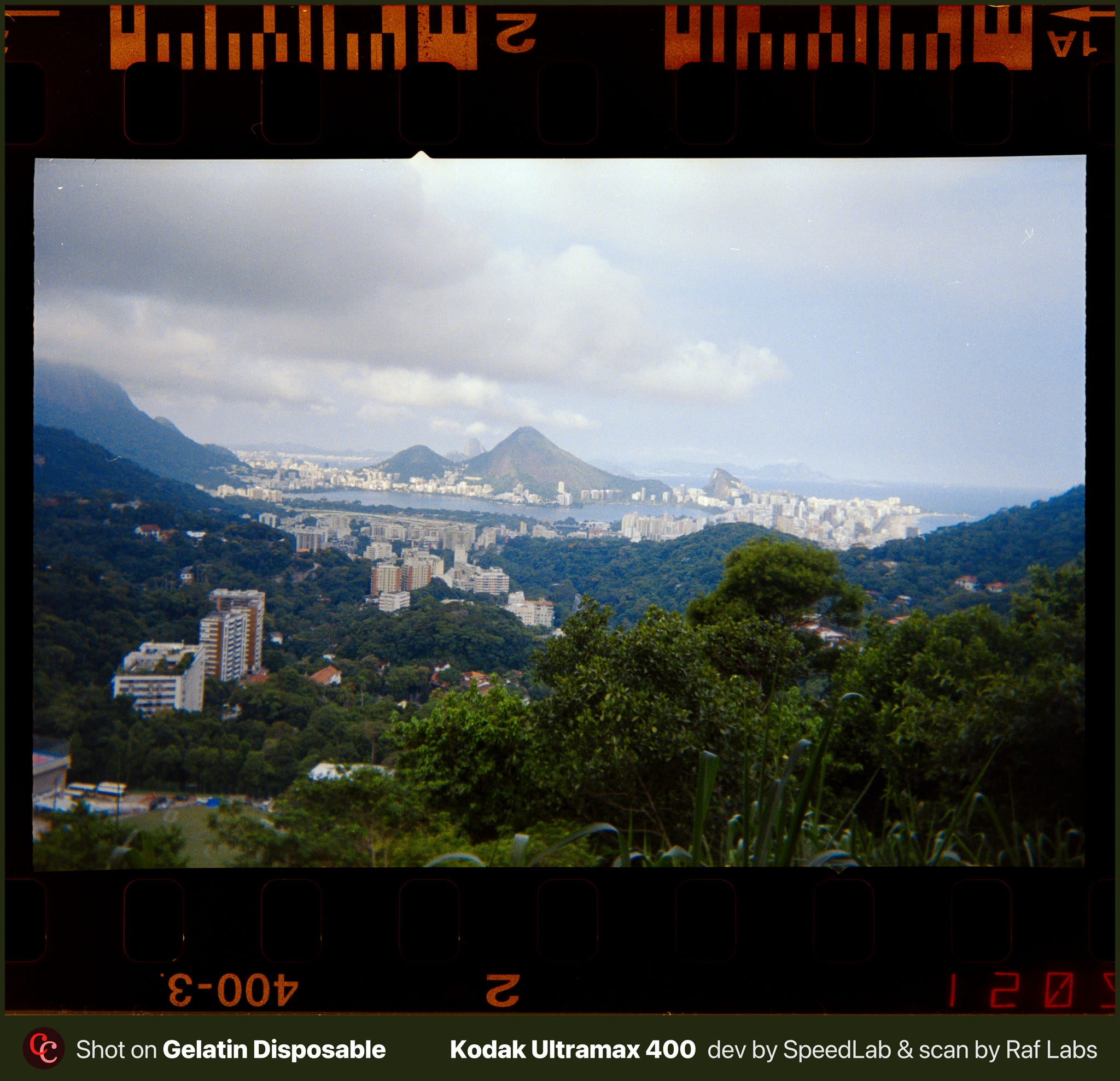
The second thing is resilience. The climbs are brutal. The streets never end. The houses stack up in ways that defy any urban planning logic. And inside those walls, more than 70,000 people wake up every day, go to work, raise children, get haircuts on a rooftop with a million-dollar view. Rocinha was once considered the most heavily armed favela in the world. Today it is a community with hotels, which they call “viewpoints”, with restaurants, shops, and people who welcome you with open arms if you show up with respect.
When the tour ended, Pix (Brazil’s equivalent to Venmo/Zelle) wasn’t working to pay our guides. So they took us to a supermarket, we withdrew cash from an ATM, and I bought three boxes of chocolates: one for each mototaxi driver and one for the rooftop barber. I wished them a happy Easter. They were thrilled and made a video call on WhatsApp to show the barber, who was just as happy. I got their contact info, added them on Instagram. Humble, hardworking people who welcome you like they’ve known you for years. They invited us to a “baile funk” (their street party, massive) the next day, but I was already heading back home.
I regret living thirty years in Rio without ever going up just as much as I regret only bringing a disposable camera.
If you’re reading this and you’ve never been inside a favela, I understand. I was that person for three decades. We grow up hearing it’s dangerous, that there’s nothing to do there, that it’s another world.
It is another world, yes. Just not in the way they told you.
Next time I come to Rio, I’m going to the best barbershop in the city, with the best view. I’m going there for a proper shave, the way my mom likes it!

Great pictures despite the disposable camera. Even more, I enjoyed the pov of someone local to Rio, and your human touch. The Good afternoon sir is priceless !!
I think in the end what emerges from your words and images is the dignity, resilience and human beauty of this community, even with its undeniable contradictions - but between a criminal organisation selling weed and the aggressive front of real estate and local governments who would kick it all to the ground tomorrow if they could, who is the villain of the story?
Wow, Raf - that view!! Thank you for sharing this experience and the photos. Another story-lesson worth learning.
"The barber working calmly, the TV tuned to an Eurocup match, Barcelona was playing. He had the entire city at his feet with that view. The simplicity of that scene stayed with me more than any postcard."
"The second thing is resilience. The climbs are brutal. The streets never end. The houses stack up in ways that defy any urban planning logic."
It seems that the favela itself is a metaphor for the people living there.