


I was in Niagara Falls last week, and from my hotel room I could see fireworks over the huge waterfall. I missed it on day 1 because I was caught by surprise at 10PM with the show, but on the second day, I was prepared and got some shots.
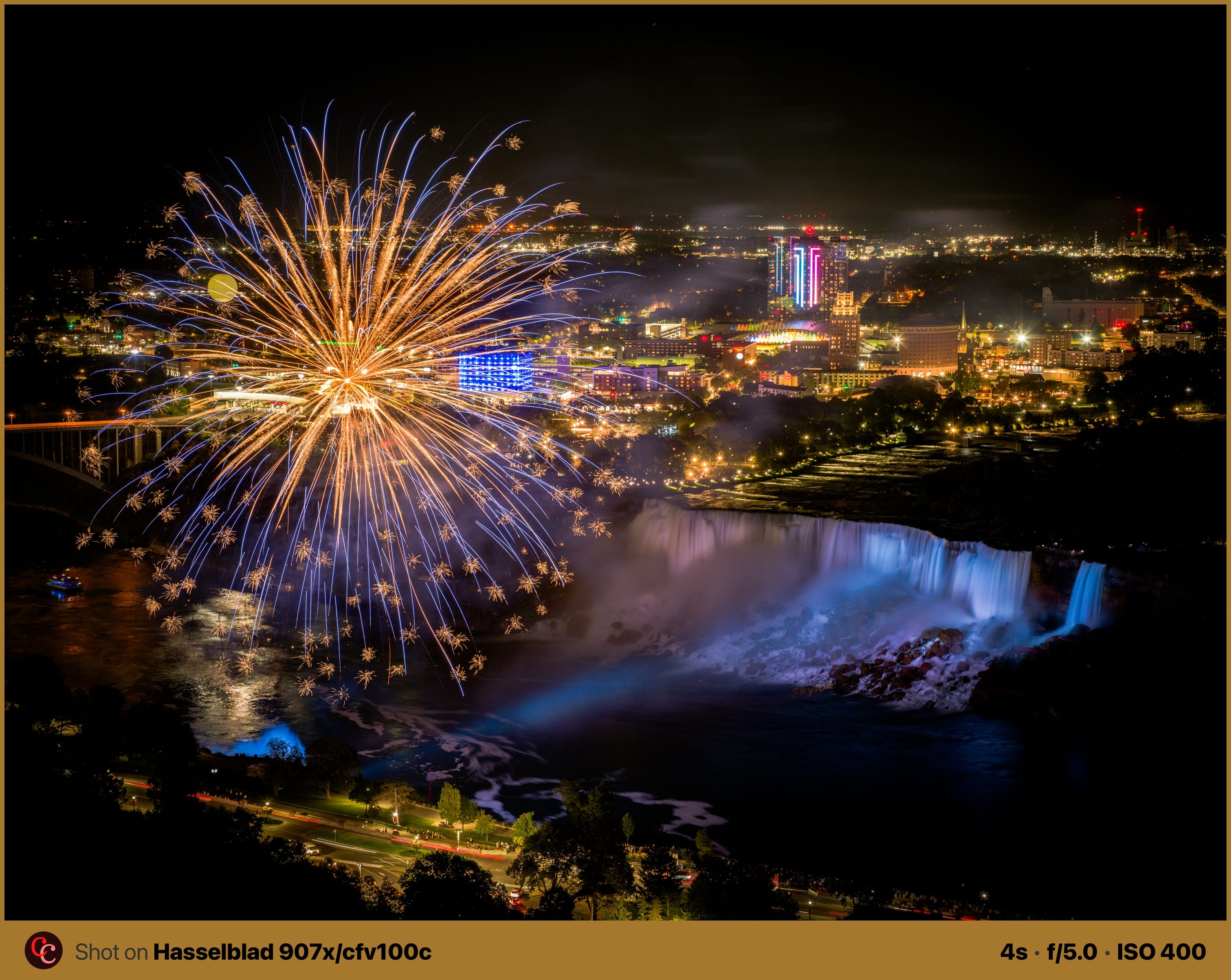
Then I came back home and thought, “wait a minute, I’ve been photographing fireworks for so long, and I think people would enjoy a Camera Clara post to talk about it!”
Well, here we are:
Fireworks are a great example of the struggle between what we see, what we intend to capture, and the result we achieve.
Just like the Moon, fireworks are hard to capture in their full grandiosity. Most people fail when trying to convert the magic moment we see with our eyeballs into something we can see and recall later with great memories, especially if relying on automatic exposure settings, or a cell phone.
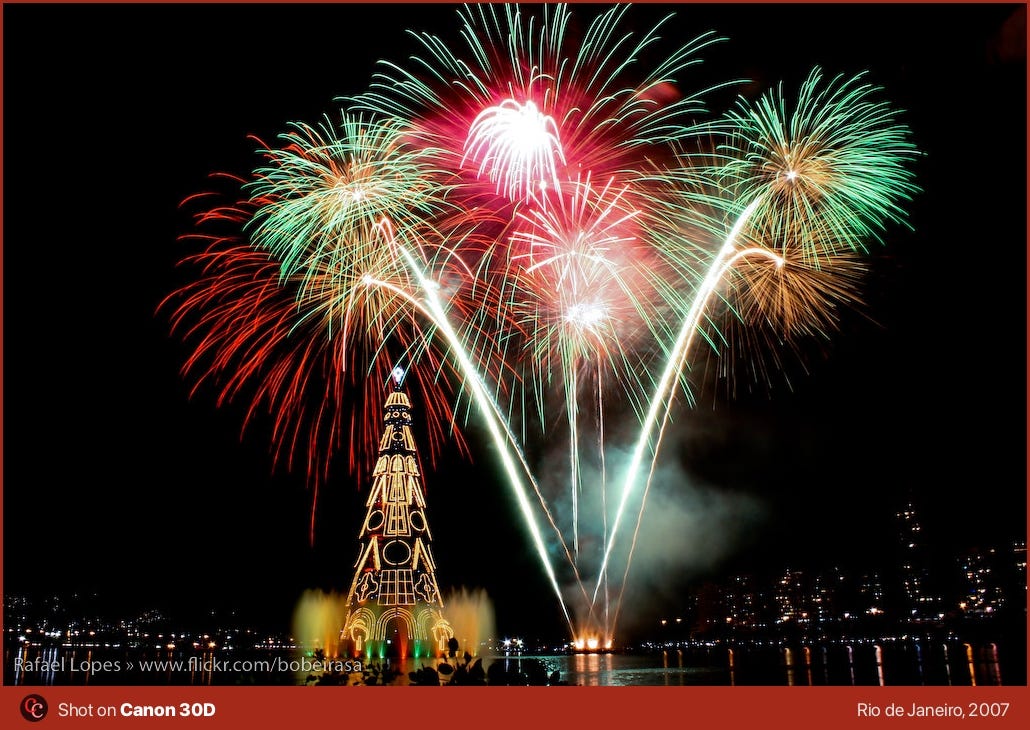
That photo was taken in 2007 by myself with a Canon EOS 30D DSLR, in Rio de Janeiro, when I was in the early stages of my photography journey. I deliberately chose this one to prove to you that you don’t need the latest and greatest to photograph fireworks. We are talking about a 20-year-old DSLR, with an 8.2 megapixel CMOS sensor, released in 2006.
Things evolved, I moved to NY, got fancier with full frame, film, medium format cameras, I witnessed more fireworks, but the principles stayed the same. And that’s what I wanna share.
Alright! Enough talking. Let’s go to the tips.

1. Timing and quickness
As soon as fireworks start, the sky is clean with no smoke, and your best shots come up early when the atmosphere is clean. 2 minutes of fireworks bursting out in the sky might be your window here, because after that, smoke gets in the way and you don’t have a clean shot. See the image below? That’s not ideal. I think the fireworks were running for like 5 minutes when I did this shot.
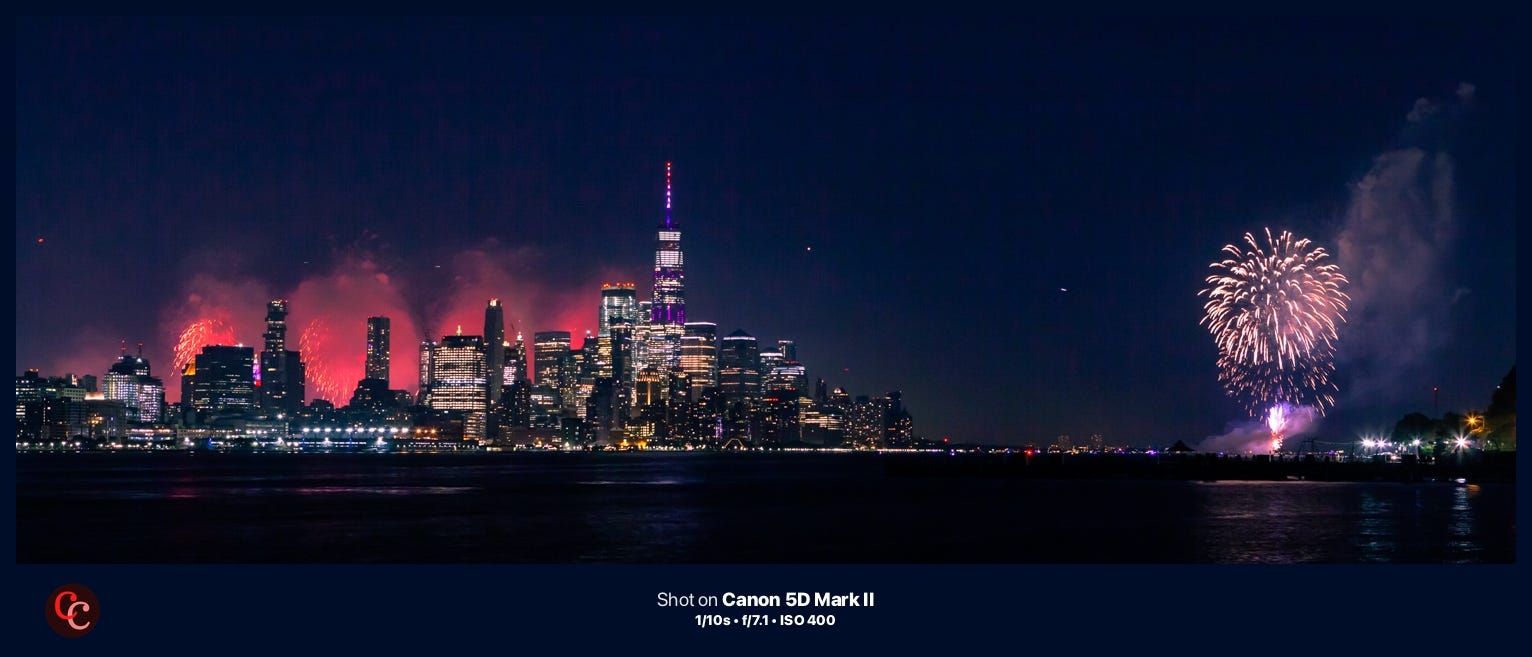
Ideally, you’d want to know what time the fireworks show starts, and test some exposures beforehand to check the exposure in the rest of the scene. Don’t fully rely on luck at show time. Get your tripod in place in advance for that.
Wait, tripod? Did I say tripod?

2. Use a tripod
You need a tripod. It is a must-have because you want an exposure long enough that it would show camera shake if shot handheld, even with fancy IBIS on high-end cameras. We are talking about something between 1/10 of a second and entire seconds, like 2, 3, or 4 seconds.
The tripod will guarantee that the fireworks’ light is drawn with no shake.
If you want a tripod recommendation, get the Sirui AT-125+B-00K (I know, horrible model name). It's stable, carbon fiber, lightweight, and cust just over a hundred bucks.

3. Compose with the scene
Don't rely on the fireworks alone! The landscape might be half of the show!
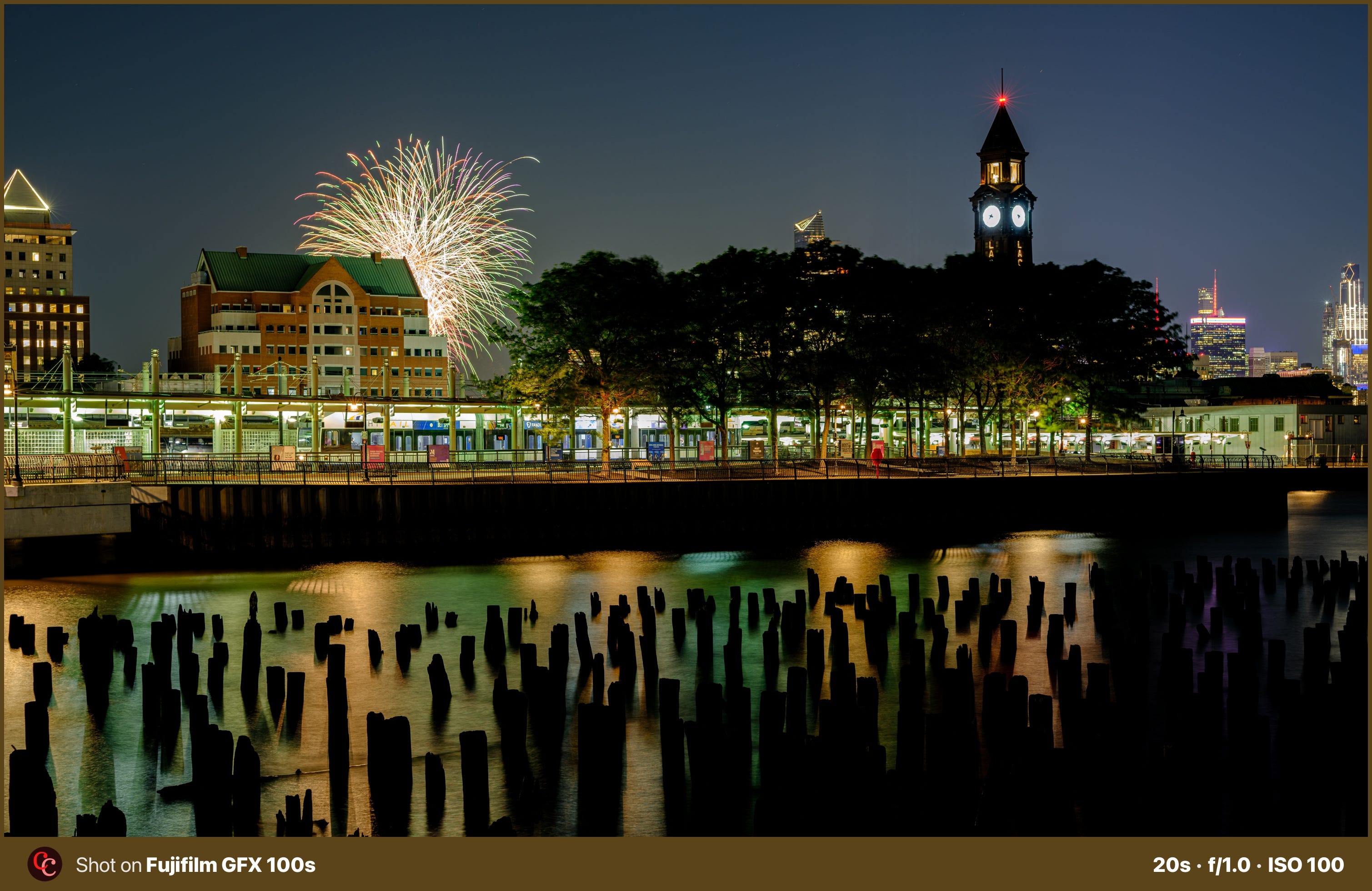
Fireworks usually don’t appear in the middle of the desert. They are naturally paired with great landscape shots. Sometimes, fireworks are as good as the super long exposure shot you will get. Explore looooong exposures, like 10 or 20 seconds. Try using a wide-angle lens and crop in post. That would help you get the whole thing within the frame, while also helping you compose the shot with the landscape.
Remember that you’re doing a long exposure shot, and if there’s water nearby, the lighting elements tend to reflect on the water.
4. Camera settings (focus, aperture, s.s. and ISO)
We are in an unpredictable field (and that’s why I don’t recommend doing this with film very much, but if you’re rich enough to burn film and get results, be my guest). Fireworks are something that explodes in the air without any control from us, so trial and error is very acceptable and there’s no shame in that.
Once my tripod is set and I have my composition, I like setting my camera ISO to 200 or 400. Ideally 200, unless I am doing a super long exposure like tens of seconds, in which case I set it to ISO 100 or 64.
Ideally, I want to lock the exposure settings and just change shutter speed, varying it according to the explosion pops. That helps me mentally count the light spread and adjust accordingly.
Start with this: ISO 400, f/5.6, 3 seconds.
And adjust from there. Something I do that always helps me is mentally counting the number of seconds a full firework takes to burst. Depending on the fireworks, it can be 1, 2, 3, or more seconds. Count that manually, set that in your camera, and do a shot, adjust, and do more.
Regarding focus, I recommend Manual Focus because you don’t want to risk the camera taking time to find focus. You can use Auto Focus to find the firework, then switch to Manual for the rest of the shots.
5. Timer or shutter release cable
This complements the tripod aspect, and it’s a rule of thumb for every long exposure shot. You don’t want to touch the camera while it’s taking the photo, so you need to work with the timer feature to eliminate camera shake as much as you can. To me, a delicate touch on the camera and a 2-second timer do the trick.
A shutter release cable is more interesting because you can explore the Bulb mode in your camera, meaning it will expose the shot for the exact amount of time you’re holding the button. Ideal to start the shot before the firework blooms, and end it right after. But even so, do the mental counting of time, for consistency.
If you wanna do this on film, this is the way, as most cameras will either give you a 10 sec timer or no timer at all.

Save that post for July 3rd, haha. I hope you enjoyed reading it!
Please consider subscribing to Camera Clara for more articles right in your inbox! Quality over quantity, with the forever love for film photography and its techniques. With a paid subscription, you can shoot me a DM anytime, and we can arrange video calls where I can help you with your photograph needs, let’s be friends.

Amazing pictures, Rafa! The first one deserves a huge print!
Love your fireworks shots (even the “bad” one). Thanks for sharing your advice.