


The appeal is clear. A traditional black and white workflow involves three chemicals in sequence: developer, stop bath, fixer. Each step has its own timing, its own pour cycle, its own bottle and risk of contamination. Df96 collapses the whole thing into one bath. You pour once, drain once, rinse, and hang. Less chemistry to store, less waste to manage, fewer steps to get wrong.
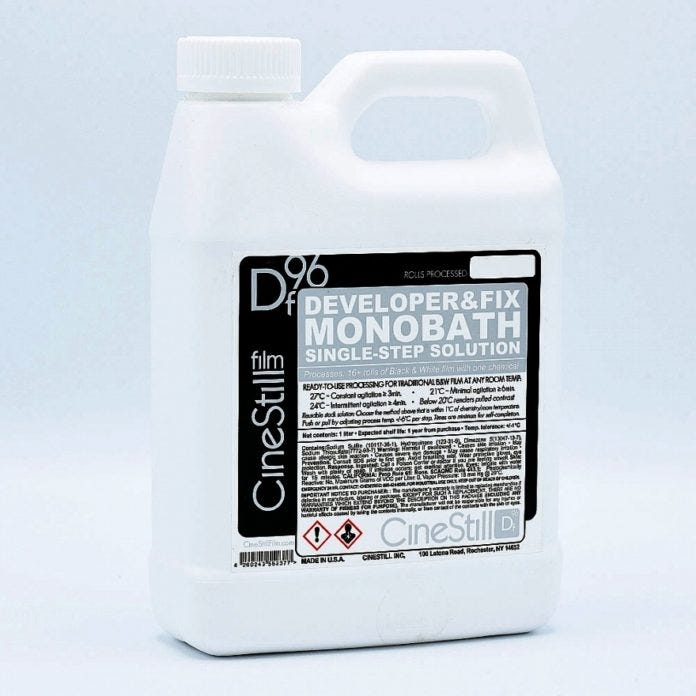
This makes the pitch for CineStill Df96 hard to resist. One bath, three minutes (fresh chems), flexible room temperature, add 15 seconds per roll. No stop, no fix, no second pour. For anyone new to home developing, or anyone tired of juggling chemistry bottles, it sounds like the easy path into black and white, right?
Well...
And in some ways, it is. The chemistry really is simpler because the chemical does it all.
The process, though, hides complexity the marketing doesn’t talk about much. In this post I want to focus on one thing in particular that surprised me, and that I think surprises most Df96 users who come from traditional developers.
Starting with the fact that…
The Df96 Monobath uses temperature for pushing, not time
Df96 as part of a small family of “unconventional” developers rather than a one-of-a-kind oddity.
Most traditional black and white developers treat temperature as the constant you hold. For instance, you stick with a specific temperature and you vary the time to push or pull. Dev charts for D-76, HC-110, DD-X, or Rodinal all assume this structure: pick a target temperature and vary time. A Tri-X at 400 in HC-110 is one time. Same film pushed to 1600 is a longer time. Temperature stays put.
The CineStill Df96 monobath flips this logic around. The time is a checkpoint, not a knob. According to the manual, 3 minutes at 27°C/80°F is the minimum time needed for the developer to complete and the fixer to finish its job (with constant agitation [recommended]). In order to push the film a stop, you gotta raise the bath temperature by 10°F (about 6°C). Lowering the temperature pulls it.
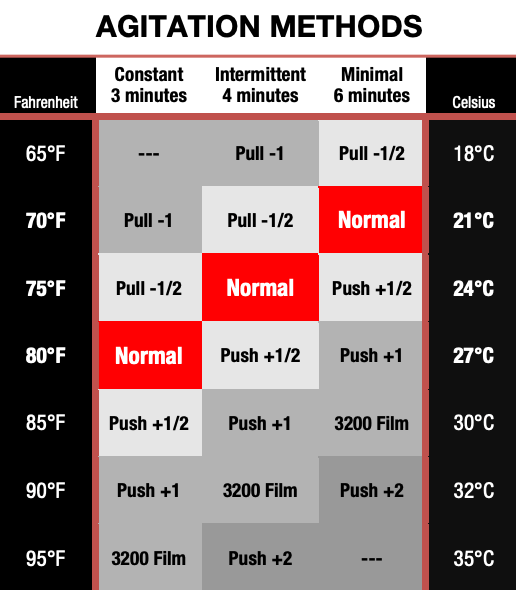
This relation between three variables: agitation method, temperature, and time, render a difference. In other words, this is a small shift in thinking that has big consequences.
With a traditional developer, a two or three degree drift during development is a mild inconvenience you can correct with a time adjustment later (or even by rebringing the roll to a bath), or just shrug off. With Df96, that same drift is a half-stop push or pull you won’t see until you scan, that makes the Df96 something more complex than it looks, and might defeat the purpose of the simplicity of just using one bottle to rule them all.
That’s why CineStill sells a water heater/circulator
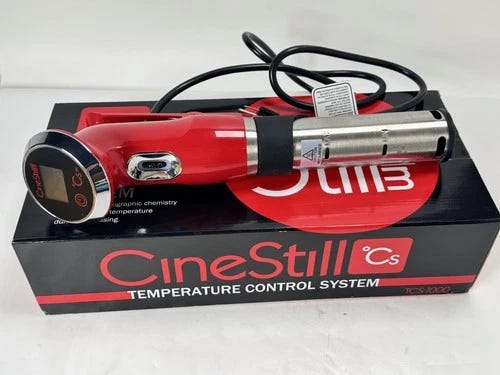
Worth noticing: CineStill themselves sell a water circulator on their site. It’s a sous vide unit dressed up for film work. The product exists because temperature control matters more than the “any room temperature” marketing suggests for their products, both for the Monobath and the Cs41 Color Simplified 2-bath kit (but that’s expected).
You can develop at any temperature in the 65-95°F range and get an image. But if you care about consistency across a roll, a month, or an archive, the temperature of that bath matters more than it would with other B&W chemicals.
OK, the water circulator solves half the problem because your chemistry reaches target temperature. But you’re still agitating by hand in a vertical tank, and “intermittent” is still whatever you think it is.
The agitation question is what makes it complex
The second thing that surprised me is agitation. CineStill’s Df96 manual gives three recipes for fresh chemicals:
3 min at 80°F with constant agitation
4 min at 75°F with intermittent agitation
6 min at 70°F with minimal agitation
It also defines what each agitation mode means:
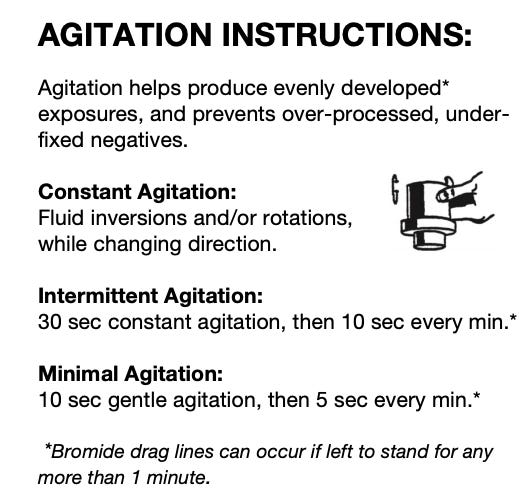
The question is: What is “intermittent agitation”? What is “minimal”? Let’s break this down, because two things jump out once I read these carefully.
1. Constant agitation is actually the least precisely defined of the three. “Fluid inversions and/or rotations, while changing direction” is a description of behavior, not a spec. How fast? How many inversions per minute? The Laboratorist decides. This ambiguity is fine if you’re doing it by hand (you’ll find a rhythm that works), but it means different people on constant agitation can still produce different results. That said, it’s the most efficient mode when you use a rotary agitation machine, which I’ll cover later on.
2. From these 3 agitation suggestions, constant agitation is the only one of the three that has a clean mechanical definition. The tank moves continuously for the full time. No interpretation required, nonstop. The problem is that constant agitation by hand, for three straight minutes, is tedious and sometimes inconsistent. Nobody inverts a tank perfectly evenly for three minutes. Your arm gets tired, your rhythm drifts, and you’ve introduced variance you can’t measure. Not to mention the fear by bromide drag lines.
The intermittent and minimal specs exist, but they demand manual timing. “30 seconds constant, then 10 seconds every minute” sounds simple, but it’s not mechanically accurate. The spec exists; hitting it reliably by hand, roll after roll, is another matter.
That’s why...
A rotary film processor REALLY helps
A rotary processor puts the tank on its side and rotates it continuously. Constant agitation becomes automatic. Same rpm, same direction cycle, every time. You’ve locked the agitation variable. No more guessing what “minimal” means because you’re not using minimal anymore.
Pair that with temperature monitoring and you’ve handled both of Df96’s variables adding complexity. The chemistry stays at spec by the water circulator, and the agitation stops being a source of variance with the rotary processor.
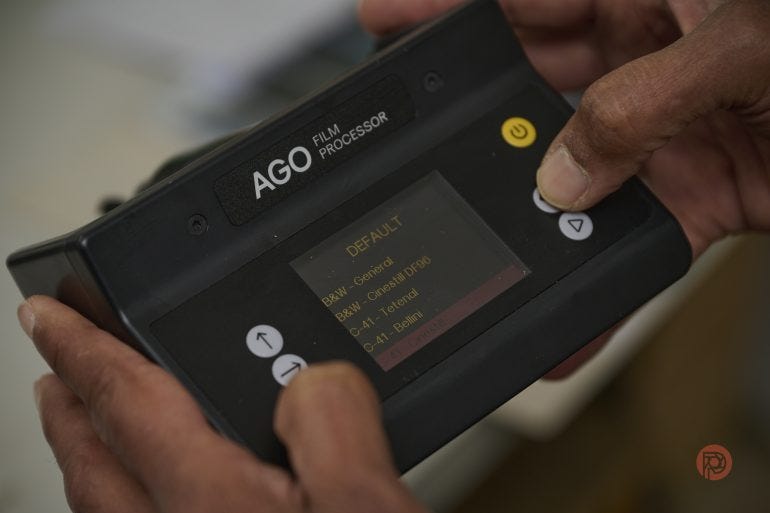
I use the AGO Film Processor from Vintage Visual. It’s a compact rotary unit that fits any Paterson tank, rotates the tank at a set RPM, and reads chemistry temperature through a probe. If the temperature drifts during the run, it stretches or shortens the time to compensate (well, that might not matter for Df96, so I’d better keep it consistent...), For Df96 in particular, this removes the two things that make the monobath inconsistent. JOBO’s rotary systems (the CPP and CPE lines) do a similar job, and there are a few other rotary options if you hunt around. The category is the recommendation. The AGO happens to be my pick because it’s small, quiet, it works with tanks I already own, and their customer support are simply stellar.
By the way, the Df96 manual also states that processing time should never exceed 8 minutes. That’s a hard stop, the chemistry is considered exhausted past that point. And since higher agitation means shorter times, constant agitation takes the longest to reach that ceiling. In practice, a fresh bottle of Df96 gets you 20 rolls at constant agitation, 16 at intermittent, and only 8 at minimal. That’s another strong argument for constant agitation, more negatives per bottle.

A CameraClara cheatsheet for Df96 on a rotary processor (AGO, Jobo, etc.)
After researching this for a while, I put together a table. I laminated it and keep near my sink in at RafLabs. Base times at 80°F/27°C constant agitation with the AGO, which also increase shelf-life), with the +15 second reuse compensation CineStill specifies, plus push columns for +1 and +2. I am making this available for you, at no cost!
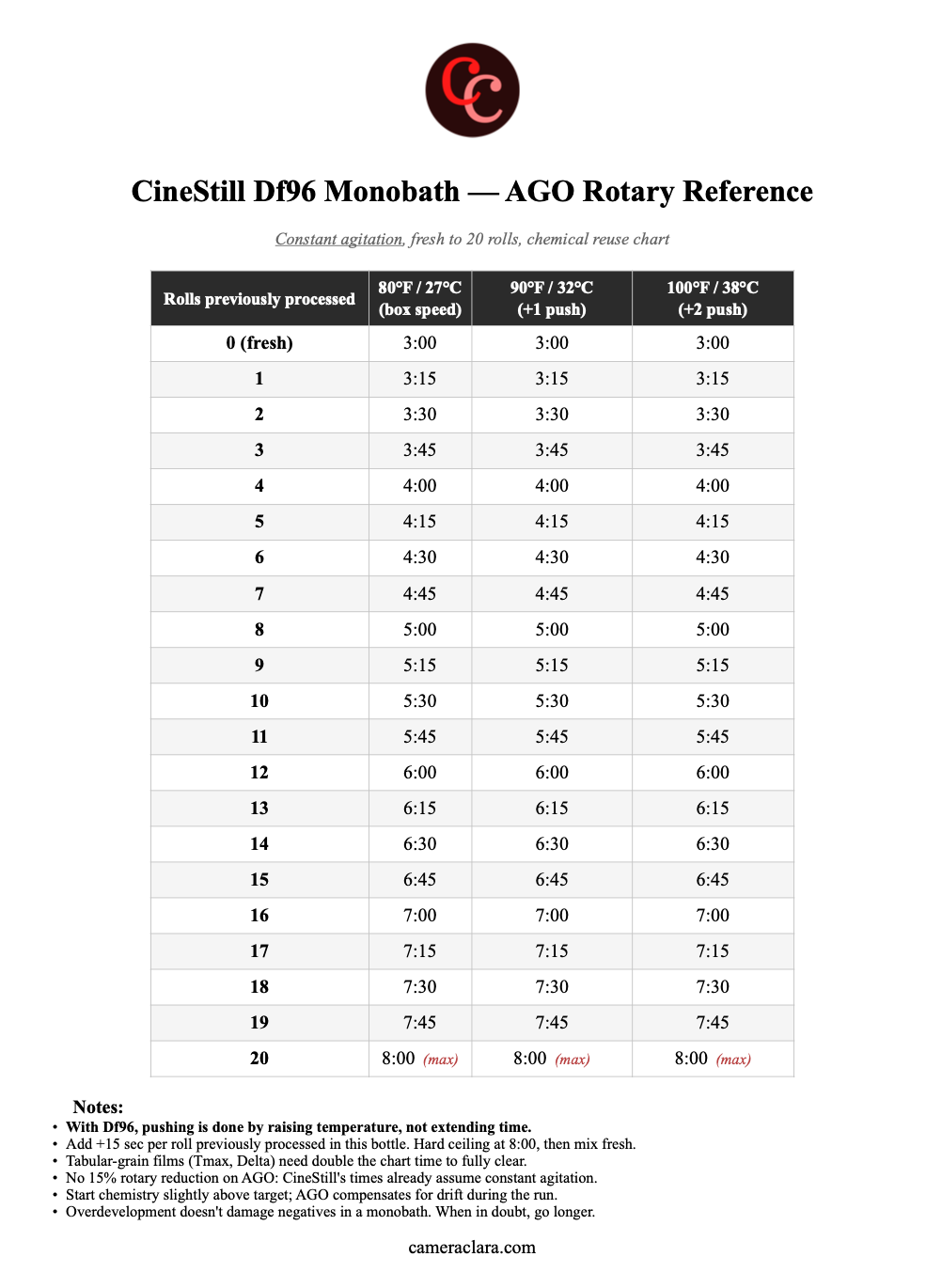


The identical time columns are the whole point. As we now know, with Df96, pushing is done by raising temperature, not extending time. The time value is a minimum for self-completion, as I said, a safety checkpoint. Temperature is what changes the development. I wanted the time repeated across columns as a visual reminder on purpose.
Simple where it counts, complex where it matters. Do I recommend it?
Df96 is absolutely worth using. The chemistry simplicity is real, and a rotary processor with temperature awareness takes care of the rest. But it’s honest to say the monobath isn’t the “pour and forget” product the bottle suggests. It’s a fast, flexible process that trades chemistry complexity for process control. If you understand that trade, you’ll get great negatives. If you don’t, you’ll wonder why your rolls look inconsistent and blame the film.
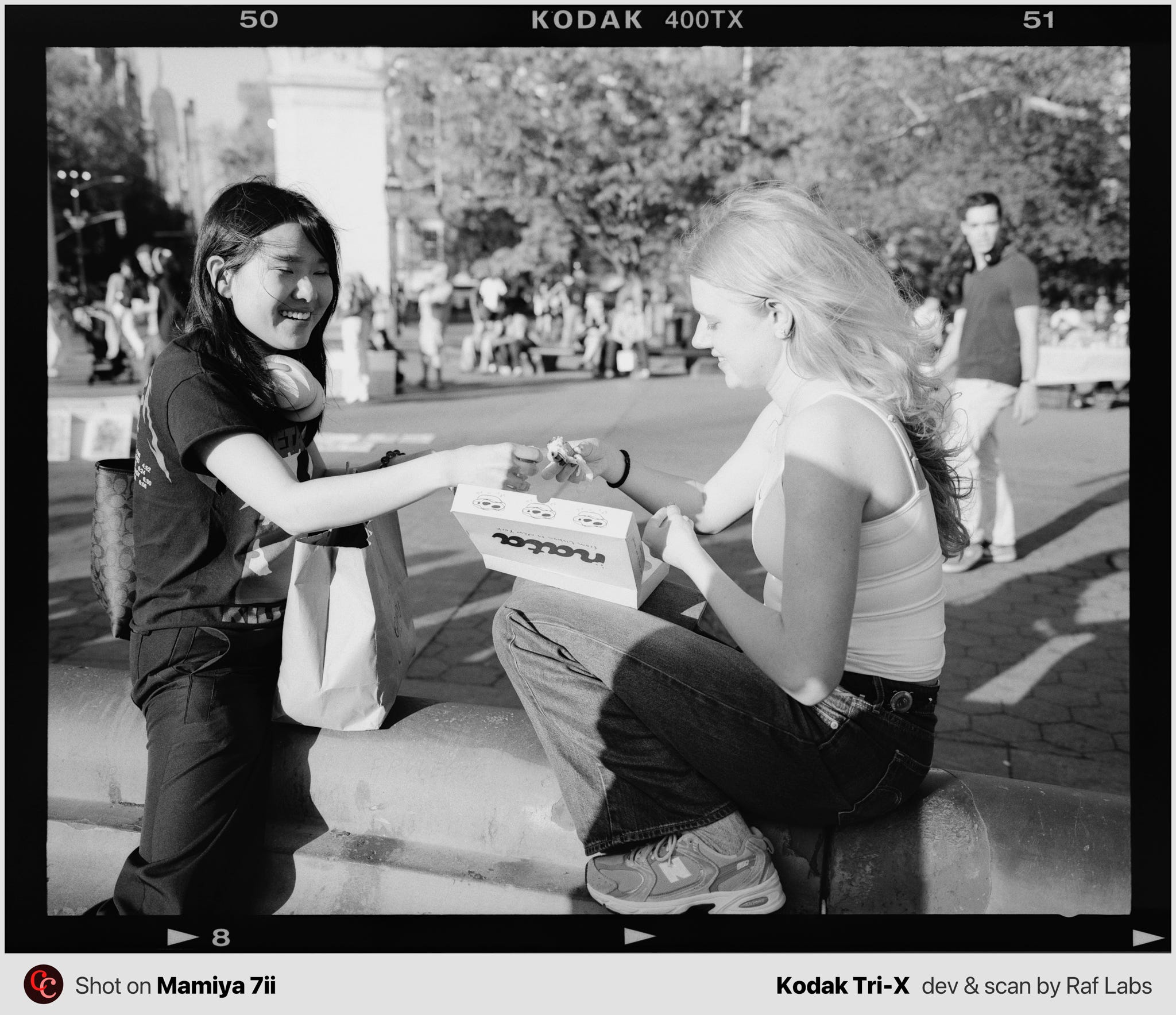
To summarize, the monobath is simple at one point and complex at another. Knowing which is which is most of the battle. Here’s a result, with a well-deserved zoom for you to observe the grain structure of an ISO 400.



Additional links
CineStill Df96 Processing Instructions (a.k.a. manual)
Additional notes
1. For readers in tropical or very cold climates: if your ambient room temperature is already past 82°F or below 65°F, passive temperature control won’t be enough. You’ll need to actively cool or warm the chemistry before pouring. A friend of mine in Manaus, Brazil (Marangoni Lens), has to ice-bath chemicals during the Summer because his kitchen sits at 35°C year-round. This is worth knowing before you commit, especially if you’re using chemicals that rely on temperature, like the Df96.
2. Worth noticing that everything I wrote here is wrote in the bottle and in the manuals. I am just sharing my discovery and points of attention you should have when using this fantastic chemical to develop your own rolls.

This is very helpful. I’ve just gotten into home development and chose the Df96 for the “simplicity”. Just about done with my first bottle so about 15 rolls so far. Mostly 35mm, a few 120’s.
I use the intermittent and it’s seemed to work well. If the pic wasn’t good I figured it was more my error in exposure when shooting.
I keep seeing info about AGO (and now it floods my IG algo lol) and it looks great. Because I may warm the Df96 to 75 but I’m sure it drops over the course of the 6 now 7 minutes (close to end of the developer lifespan of 16 rolls).
How did you compensate for that prior to using the AGO? Or have you only used it in the AGO?
Great article, appreciate it!
Interesting product. Thanks for the detailed write up!
For someone like me who does manual inversion, I think the temp and inversion frequency variables would make this more complex than my current method (x-tol 1:1 with only time shifts for various film stocks/push/pull).
An all-in-one product seems easier, but thank you for pointing out that there is more to look at than simply the combination of chemicals into a single bath.